Women’s History Month Reads – Illustrating Hidden Lives
Happy Women’s History Month!
You might have heard the phrase “history is written by the victors,” and one place that’s quite evident is the presence of women throughout your textbooks. Women and other marginalized groups are often excluded from the narrative, either deemed unable to lead or hold positions of power like men, or relegated to warning fables when they dared to break out of the mold.
So it’s exciting to me that recent decades have prompted a resurgence in feminist history, as academics and authors focus more on digging historical ladies out of the ruins. Still, most heroines (and villains) of history aren’t as high-profile as your Joan of Arcs or Elizabeth Tudors. Where do you even start learning about them?
Well, I love a good list. And so, it seems, do many of the authors making the iconic women of history accessible to entry-level historians. My bookshelves are filled with introductory courses on hundreds of women – just brief look-ins at these fascinating figures, which you can then use as a jumping-off point for more research.
Consider this your guide to those guides!
A nice thing about the books below – by illustrators Ann Shen, Jason Porath, and Rachel Ignotofsky, and author/illustrator duo Mackenzi Lee and Petra Eriksson – is that there is astonishingly beautiful, distinctive art to accompany each profile. But don’t just dismiss this article as simply “picture books!”
The life of a woman wasn’t – and still isn’t, for many – smooth sailing. There is some rough content alongside these creative pieces of art. For some of the players, we appreciate the trials and struggles they went through and overcame; for some, we (and the authors) are forced to acknowledge that these are no shining heroines of the days of yore. These were straight-up bad people.
(A quick note about this point and then we’ll not speak of it again, because I don’t like when people say mean things about me, and so I don’t want to review too many books negatively here. Karen Karbo’s In Praise of Difficult Women could – for most of its profiles – also join this list. There’s lovely art and takeaways about groundbreaking women. On the other hand, as the title says, it is very much praise of these women. Fine, it was published before J.K. Rowling went full transphobe, but well after Lena Dunham made headlines for allegedly sexually assaulting her sister and well well after it was clear that Coco Chanel was a literal Nazi. I mean, Karbo wrote an entirely separate biography of Chanel – it’s not as if that’s a fact you can miss. Yet she just brushes off being a Nazi – whoops, Chanel was sleeping with a Nazi agent; whoops, she tried to kick her Jewish business partners out of the enterprise; whoops, she got exiled to Switzerland after the war as punishment for being a collaborator. But readers told Karbo they thought Chanel seemed mean, so she’s the victim 😦
Everybody is a product of their time, and has biases and views that will likely seem outdated down the road. But here’s the thing: being an awful person is not a product of your time. There are some things that are never and have never been okay, and most people with common sense and basic decency recognize that. One of those things is being a Nazi.
There are so many good books that address and at least attempt to explain the thorns in historical figures’ pasts. This is generally not one of them. Spend your time reading books that don’t apologize for Nazis, please. Or if you do choose to read those, employ your critical thinking skills and don’t trust the authors at face value.)
Moving on.
Ann Shen
I love Ann Shen. Her art is exquisite, and that’s a big part of it. But one thing I also love is that, between each of her three books, she approaches the topic of historical women differently.
Her first, Bad Girls Throughout History, focuses on women who were “rule-breakers” and trendsetters. They’re not bad, as in evil (mostly – although, to my previous point, she does include Margaret Thatcher, so just skip that page and pretend it doesn’t happen), but bad as in mold-shattering.
Next comes Legendary Ladies, focusing not even on women of this world but legendary goddesses and mothers of myths. It spans cultures around the world and thousands of years apart, yet shows how alike humans truly can be when it comes to their hopes, needs, and daily lives.
Last is her most recent release, Nevertheless, She Wore It. This final book focuses on moments in style that changed our culture, and shows just how powerful that most traditionally feminine of domains, fashion, can actually be.
(Sit down, Chanel, you’re only in here for one piece of clothing and it’s ugly.)
Something about the brushstroke style of Shen’s lettering and art works together so well, you could almost picture these women as cheery friends, ready to jump off the page and head to brunch with you. It’s not an overly realistic art style, but you can easily tell who each of these women are – especially the more modern ones – and the whimsy is as entertaining as the content.

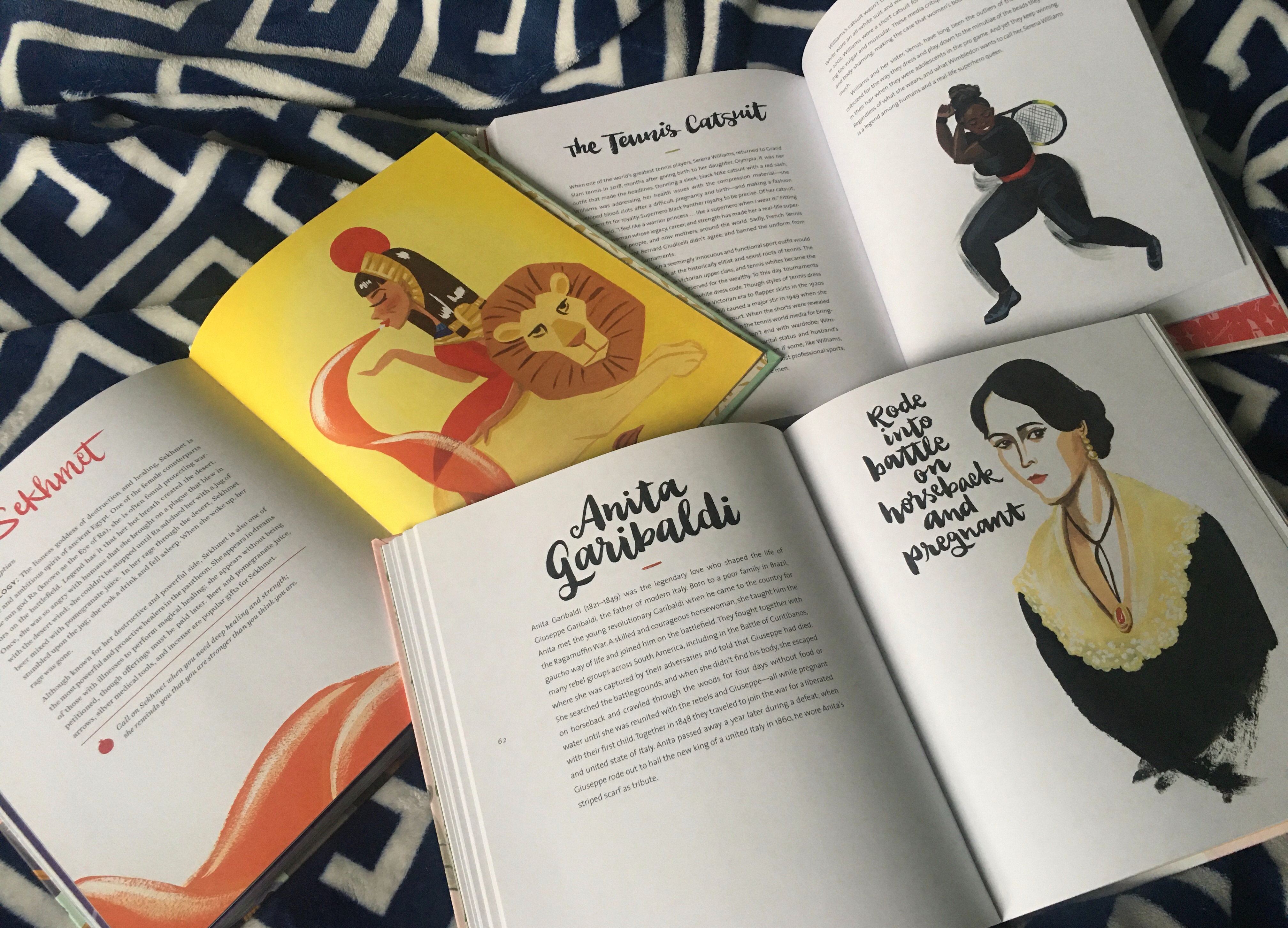
Come to read up on your favorites like Cleopatra VII and Catherine the Great, stay to learn more about (one of my personal historic crushes) Nellie Bly or Madam C.J. Walker. Immerse yourself in the deities of other cultures, some millennia old, and examine what these goddesses and their myths can tell you about those peoples. Learn why it’s groundbreaking every time you’re able to go out wearing jean shorts and wearing red lipstick. There’s plenty of info here to start your nosedive into more in-depth histories.
Not sure which off-the-beaten-path woman to learn about first? No problem.
My favorite figures: Boudicca, a Celtic tribal leader who led an impressive revolt against Roman conquerers (read M.J. Trow’s Boudicca for more information); Khutulun, Genghis Khan’s descendant who refused to marry any man who couldn’t beat her in wrestling; Anita Garibaldi, the revolutionary and rebel warrior; Annie Oakley, the famous – and first female – sharpshooter; Mary Blair, an artist for Disney who supervised early animated films and the creation of the “It’s a Small World” ride
Jason Porath
Some of you may be more familiar with Porath as the artist behind the blog “Rejected Princesses.” What started out on Tumblr has grown into two (sizable) volumes full of Porath’s Disney-esque graphics and hundreds of stories to boot.
A nice thing about these books is that there are content warnings on each story, from the benign and inspiring to the truly violent or tragic. If you’re a teacher looking to scan a few pages to share with your class during a future Women’s History Month, you’ll know right where to look to find what’s appropriate for your classroom.

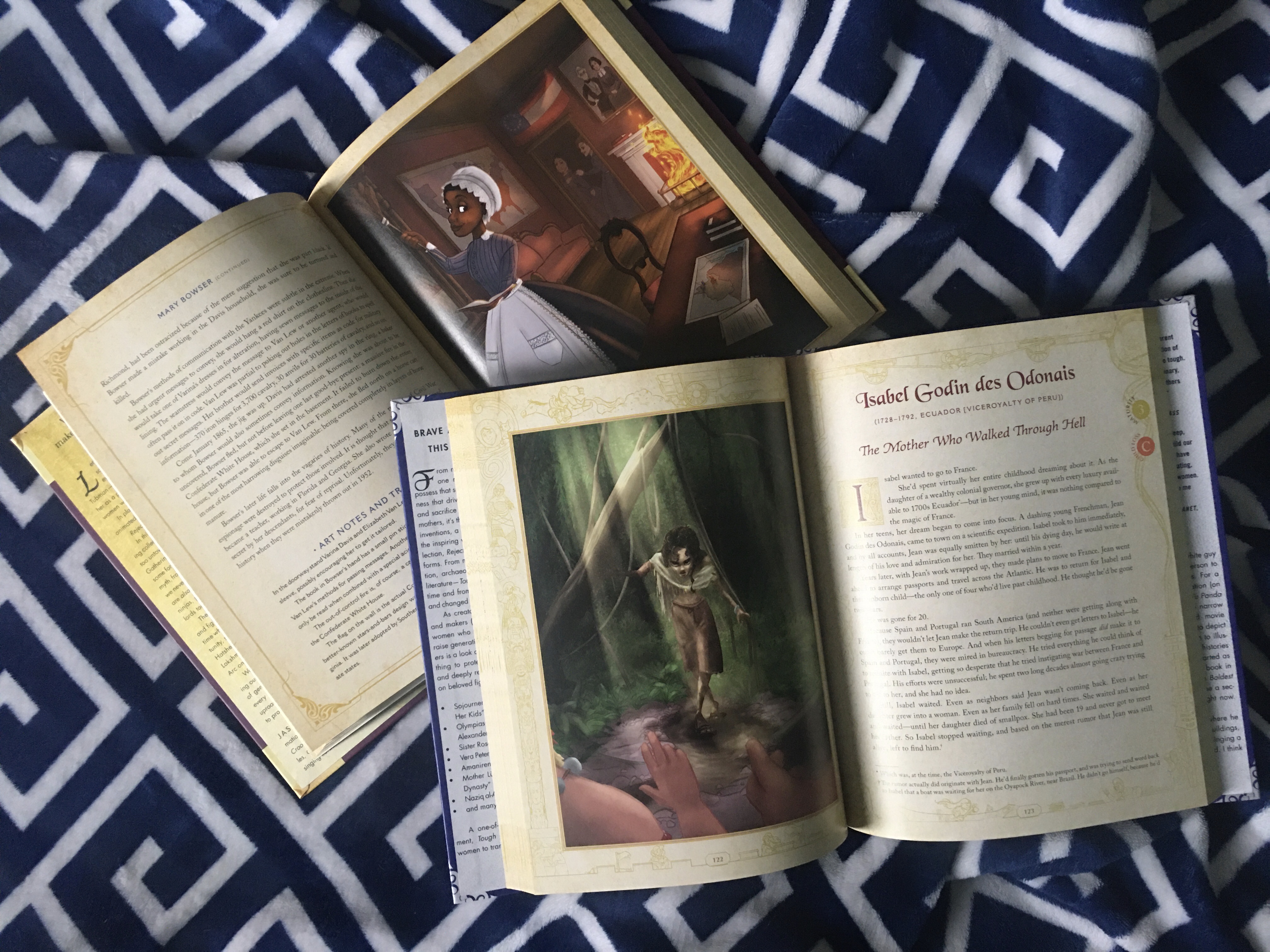
Additionally, these profiles are more than just morsels. Porath has really done his research, tracking down obscure stories and women I haven’t found mentioned in nearly any other compilation. For some, all that’s known – or rumored, depending on the veracity of the tale – is in his book, and so your deep dive won’t take you much further.
I’ll admit I was an avid follower of Porath’s blog and was disappointed when he started posting less and less. But since the result was these two gorgeous books, I think I’ll forgive him this time.
My favorite figures: Alfhild, a legendary Viking who escaped a betrothal by becoming a pirate; Mary Bowser, a Union spy who posed as a slave in Jefferson Davis’ household and actually set the Confederate White House on fire (read Karen Abbott’s Liar, Temptress, Soldier, Spy: Four Women Undercover in the Civil War for more information about Bowser and Elizabeth Van Lew, Bowser’s patron who freed the family slaves as soon as she had the power to); Theodora, former courtesan who became empress of Constantinople; Caterina Sforza, the “Tigress of Forli” who, when one of her sons was captured and threatened with execution, pulled up her skirts to flash the army and essentially said “go ahead and kill him! I can make more!”; Isabel Godin des Odonais, an Peruvian woman who married a French explorer and trekked through the Amazon alone after her party died to find him (read Robert Whitaker’s The Mapmaker’s Wife for more information on Isabel and her husband Jean’s scientific expedition)
Rachel Ignotofsky
Ignotofsky’s art style is so unique, hers are by far the most eye-catching of these books. While some of the small, curly font containing more snippets of fact around each illustration is difficult to read, the effort is more than worth it across Ignotofsky’s three books, covering women in sports, art, and science.

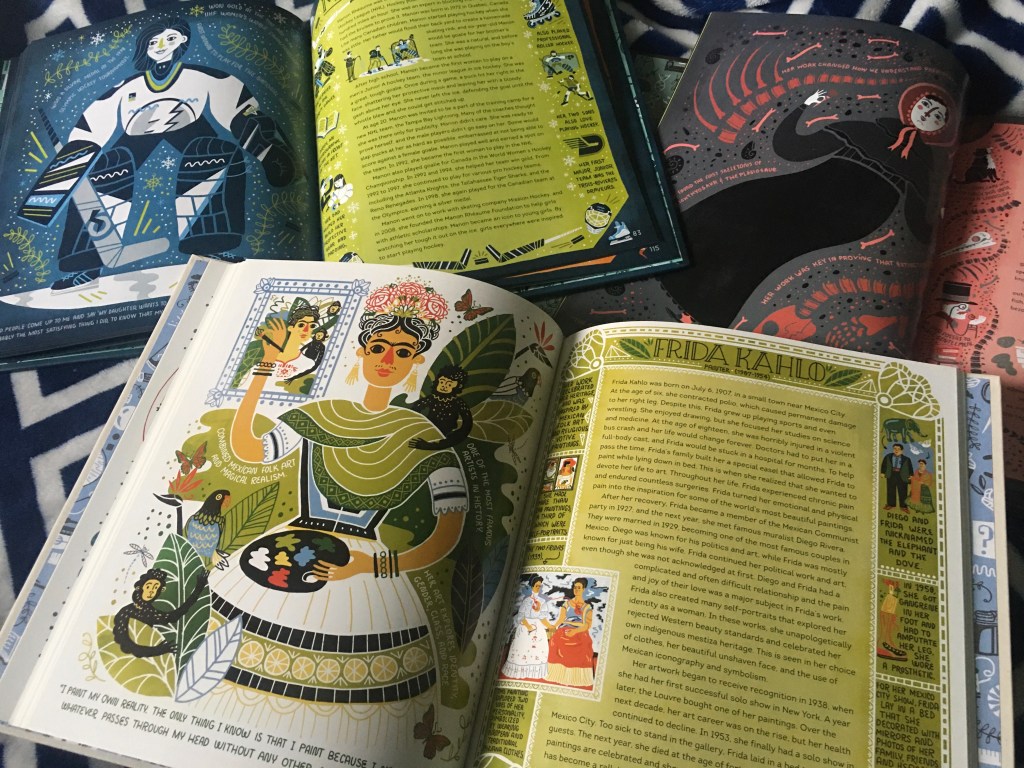
Personally, I am a big sports fan, and while I enjoy aspects of science and art I was never particularly good at either field (well, not that I’m good at sports, either). You can guess which book of the three is my favorite, and which contained the most familiar characters for me.
But there was one uniting factor across these three: I finished them and felt really, really untalented.
Not that that’s any fault of Ignotofsky’s – most of us will never achieve anything like the 150 women detailed across the series. But my goodness. Seeing what some of these women did and the significant changes they effected at such a young age was astonishing. Meanwhile, I’m sitting on my couch drinking a beer writing a way-too-long post for a blog with three whole followers.
My favorite figures: Mary Anning, fossil hunter and early paleontologist who had the distinction of being played by Kate Winslet in the recent movie “Ammonite”; Alice Ball, a chemist who became the first African-American AND first woman to graduate from the University of Hawaii; Babe Didrikson Zaharias, multi-sport wonder and elite Olympian; Manon Rhéaume, the first woman to play in a professional hockey game; Lee Miller, war photographer who was among the first to expose the horrors of the Holocaust and concentration camps
Mackenzi Lee
The last of the illustrated compendia I’m covering here is Mackenzi Lee’s Bygone Badass Broads. While it’s Lee’s only book covering historic women, she does have a book called The History of the World in Fifty Dogs, which is also extremely my style.
Anyway, this cute little book hearkens back to Shen’s Bad Girls Throughout History in that it addresses the groundbreakers and game-changers of the past. But unlike the others, the art (by illustrator Petra Eriksson) is darkly stylized, not necessarily more realistic than Shen’s sweeping brushstrokes or Porath’s Disneyfication but certainly more arresting. It lends an air of seriousness to the book, though Lee’s entertaining writing balances it out.
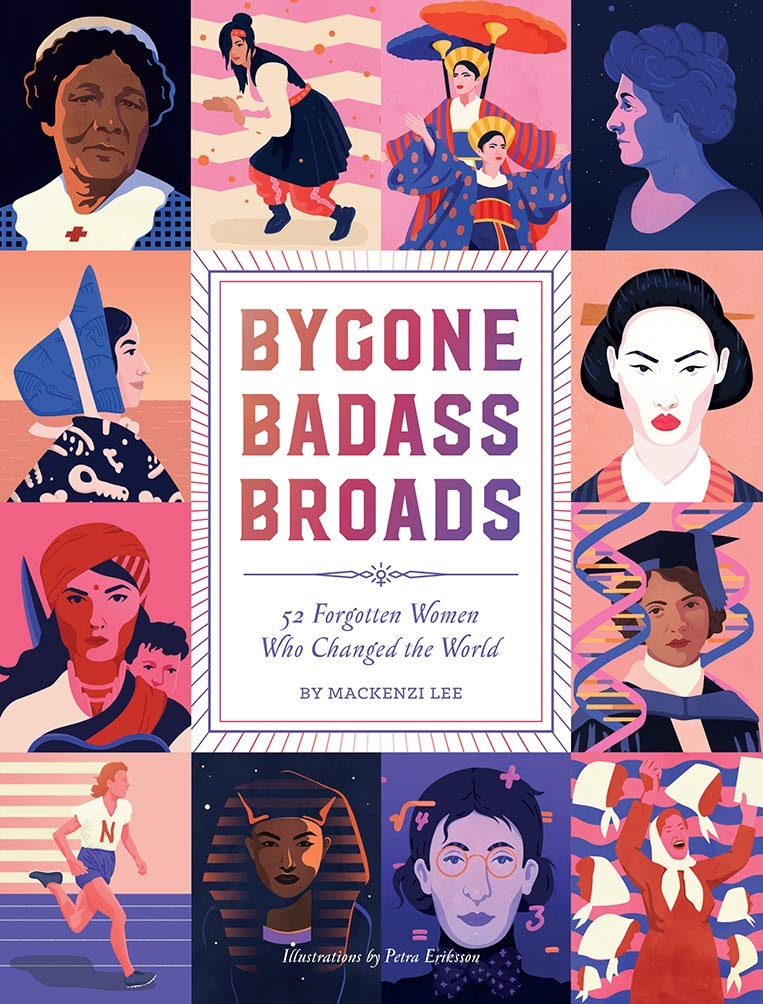
There is something of an overlap between some of the more notorious characters in each of these volumes – you’ll start to get sick of Cheng I Sao (sometimes spelled Ching Shih) and Ada Lovelace – but as they all bring different characteristics and some unique outliers to the table I find it more than worth it to have them all on my shelves.
My favorite figures: Sybil Ludington, a sixteen-year-old whose midnight ride matched Paul Revere’s own; “Stagecoach” Mary Fields, a freed slave who became a postal carrier in the wilds of Montana; Noor Inayat Khan, a descendant of Tipu Sultan who acted as a spy and radio operator during WWII until she was executed at Dachau; Julie d’Aubigny (“La Maupin”), whose bio in the book – “Bisexual Swordswoman, Opera Singer, Hell-Raiser” – says it all; Eustaquia de Souza and Ana Lezama de Urinza, teenaged Bolivian vigilantes working to clean up crime in their town while also dating
History has made several fantastic developments in recent years, not least of which is giving scholars the means and the backing to learn more about the women previously lost to the sands of time or myth. The accessibility of history now, in books like these – beautifully illustrated with bite-size springboards of information – will surely turn the heads of some former students who bemoaned the subject as dry and stuffy.
“Remember the ladies,” Abigail Adams so famously wrote to her husband John as he was away with the Continental Congress in early 1776. Thanks to talented authors, illustrators, and historians like these, the ladies are not in danger of being forgotten ever again.
Check back soon for a follow-up to this post for those of you who prefer more text-heavy non-fiction about women of history! From pirate ladies to royal mistresses, ancient Egyptian rulers to the twisted Renaissance dynasties of Europe, there’s a lot to look forward to and add to your library list this March.
Listicles Non-Fiction books Buying New Bookshelves Non-Fiction Women's History Month

 Buying New Bookshelves
1 Comment Leave a comment ›