Women’s History Month Reads – Deep Dives
Whewwww! We are really cutting it close to the end of the month here. That’s okay, there’s still time to sneak it in.
You’ll recall from the previous Women’s History Month post that I am rather a fan of “listicle” books, much like the content on this site so far. That post focused on some beautifully illustrated books chock-full of historical ladies, with an emphasis on the imagery and an assumption that the reader would use them as a jumping-off point for a deeper dive into, well, more word-heavy resources.
This is the flip side! These are the word-heavy resources!
Now, these books also cover a wide variety of women. None of them are singular biographies about a historical figure and her impact. However, they do offer more information about said figures and the thematic context in which they fit into our historical register. Fascinating if not totally academic, these are a great stepping stone between first hearing about someone and taking a more intentional look into their story.
Warrior Women by Pamela D. Toler
There I was at the library last week, fresh off writing my first Women’s History Month post, when – bam! This book was staring at me from the end of a display, whispering at me to read it and add it to this post.
Well, okay!
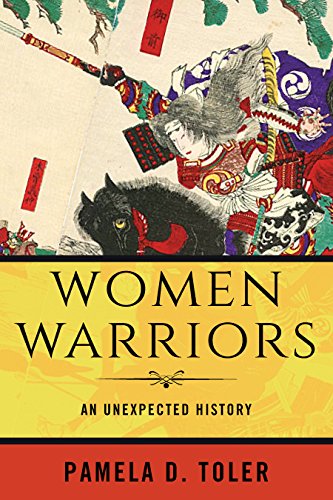
As you may be able to tell from the title, the theme of this book focuses on women who were warriors, in this context defined by the author as “one who remains in the theatre of war, near the front lines, giving orders, planning operations, and making command decisions, but someone who is not expected to lead the charge personally.”
This scope includes warrior queens, women soldiers who disguised themselves as men to be able to fight, pirate captains, rebels, and many more in between. Basically anyone who a weird little girl would see in media and say, “ooh! I want to be them when I grow up!”
I mean, I still do that.
Because this book focuses on that theme, it’s easier to break down into sections about motivations, rather than a common time period or location, to tie some of these actors together. For example, mothers who took up arms because of – or in spite of – their sons, or conversely, women who earned power or felt inspired to go to war due to their relationships with fathers or father-figures.
Unfortunately – as the author notes many times, in footnotes dripping with frustration at the male species as a whole – even for more recent women, reports and historical sources are all filtered through the eyes of men: men who wrote the stories and men who would consume the stories. There was no appreciation of Artemisia I‘s fighting skills and knack for self-preservation in ancient Persia or Greece – it was all about the shame of being beat in battle by a woman. Parsing through that rhetoric is exhausting, but with Toler on your side, you know you’re in fine company to do so.
Relatedly, if you enjoy history books by and for women, with little patience for stupid men of the past, I just finished Unmentionable: The Victorian Lady’s Guide to Sex, Marriage, and Manners by Therese Oneill. Those poor nineteenth-century women really went through it – not to mention you’ll get mad every time you eat Kellogg’s-brand cereals after you finish this one.
My favorite figures: Rani Lakshmi Bai of Jhansi, a symbol and leader of the 1857 “Indian Mutiny” against British colonial rule; Buffalo Calf Road Woman, a Cheyenne woman credited with delivering the blow that unhorsed Custer at the Battle of Little Bighorn; Queen Wilhelmina of the Netherlands, who kept trying to join the Dutch forces on the front lines and fight the Nazis in person; Cynane, the half-sister of Alexander the Great whose legacy began with killing a rival queen in hand-to-hand combat as a teenager; Princess Pingyang, whose “Army of the Lady” helped found the Tang dynasty – and upon her death, her father, the new emperor, pitched a fit until she was allowed to be buried with military honors befitting a general
Pirate Women by Laura Sook Duncombe
Another one where the theme is probably pretty clear from the title.
…or not! 😉
What does it really mean to be a pirate? Most of us automatically imagine the Golden Age of Piracy, those idealized years of yore where schooners and swashbucklers ran rampant around the Caribbean, burying treasure and keeping the cannon industry – pardon the pun – booming.

The Golden Age, depending on your definition, actually could have lasted for less than a decade. In the whole wide history of sea travel, that’s a pretty limited look at its ubiquitous ne’er-do-wells. From Cilician pirates and the so-called Sea Peoples in antiquity to the more recent Vikings and Barbary corsairs, there’s a lot of ground (or water) to cover beyond that swath of the early 1700s.
Like a lot of older sources, especially sources about people (i.e., women and minorities) who push the boundaries of societal norms, there’s a lot of gray area. Confusion and mixed messages surround what these women actually did, how they were portrayed, and in some cases, whether or not they even existed! However, even if they were fictional, the power of their stories served to impact future generations and the long catalogue of pirate-related literature, and so they are worth including in any study.
This book also wraps up with a look at how pirate women have been portrayed in media, from early silver screen flops to the blockbuster “Pirates of the Caribbean” series. As a “Black Sails” fan myself, I would love to hear what Sook Duncombe thinks of the representation in that!
My favorite figures: Anne Bonny, who earns a spot here for remarking upon “Calico Jack” Rackham’s capture and death, “if he had fought like a man, he need not have been hang’d like a dog”; Grace O’Malley, the fierce Irish matriarch who rolled up to Elizabeth I’s court and demanded an audience with the queen (read Judith Cook’s Pirate Queen for more information); Sayyida al Hurra, whose family fled the Reconquista in Spain and who ultimately led corsair crews on revenge missions against the Spanish Christians; Jeanne de Montfort and Jeanne de Clisson, two of the three eponymous figures in the “War of the Three Jeannes”; “Gunpowder Gertie,” a fictional pirate created by a teacher in British Columbia to get her students interested in local history – but in the process, people across all of Canada came to believe Gertie was real!
Women of Discovery by Milbry Polk and Mary Tiegreen
Okay, do not get mad at me, but… I haven’t actually read this one yet. I’m looking forward to it! But I haven’t really delved in more than a few pages yet to get a feel for the authors’ biases and writing styles.
So why am I including it here? That’s not a very good recommendation one way or another, you’re thinking. Well, you’re right. If it sucks I’ll come back and edit this post and remove it, I promise.
But I’m including it because it tells an entirely different story than what we’ve seen before! We know of women like Nellie Bly and Amelia Earhart who were quite literally pioneers and record-breakers, but there are so many more out there that took this incredibly physically daunting field dominated by men and made it their own.

I think many of us have a complicated relationship with media about discovery or exploration – it takes a careful hand and thorough research to write without sounding like you’re a colonial apologist. There are many peoples and places that feel the sting of European imperialism today and remain affected by centuries of conquest. The challenge of writing a sensitive yet accurate tale of “discovery” is further hindered by the fact that most of our records come from the conquerors and, of course, contain layers upon layers of bias and misrepresentation.
I’m very interested to see how that’s addressed in this book: granted, women were not on Columbus or de Soto’s ships sailing over to wreak havoc on the New World. However, they could and did continue to contribute to imperial settler mindsets, and I’m hoping that the authors address such things appropriately and with the respect for the displaced societies they deserve.
My favorite figures: Okay, I thought I would still know enough of these women to give you the usual list, but I don’t! That’s exciting – what a fun reading experience I have ahead of me.
Princesses Behaving Badly by Linda Rodriguez McRobbie
I’m a big Disney gal, although growing up I was much more into the villains than I was the princesses. That’s still true, but I appreciate the push Disney’s made in recent years to make their princesses more diverse and empowered, and princesses have grown on me a little bit.
Happily, this isn’t one of those weird bleak fairy tale re-tellings that tries to shock you by one-upping the Grimms’ original scare factor. (Everyone knows that “Snow White” and “Hansel and Gretel” are already dark, moralistic warning stories. Enough with trying to be edgy. No more edits of the Disney princesses as goth girls, either, please.) No, instead, these are actual tales of princesses and nobility who, alas, were not saved by true love’s kiss – more often than not, they were condemned by it, either to death or a life of misery shackled to a king and court they despised.

Maybe Disney princesses don’t traditionally have a ton of choice over who they would marry… but at least Prince Phillip wasn’t a Habsburg. That family tree is more like a family Christmas wreath.
(Eventually, you read enough of these books and get to the point where you are just so infinitely grateful you were born in the 21st century it could almost make you cry.)
Anyway, back to the point. The last of our thematically organized books, our bedeviled heroines are grouped into sections based on their defining reasons for inclusion – woe betide the ones labeled “Floozies” or “Usurpers.”
There are some unique entries we haven’t encountered in other books yet, such as an amnesiac Romanov pretender and Gloria von Thurn und Taxis, surprisingly – and sadly – not the Princess Of Public Transport. Fun blurbs in between chapters shed light on even more royals (and wannabes; there’s a whole section on women who faked their titles, not to mention the chapter on Caraboo). You’ll definitely not be lacking in information or entertainment by the time you finish this one.
My favorite figures: Lucrezia Borgia, the much-maligned Renaissance muse and member of the notorious Borgia dynasty (read Leonie Frieda’s The Deadly Sisterhood for more information on my girls Lucrezia and Caterina Sforza); [Saint] Olga of Kiev, who allegedly set her enemies’ cities on fire via flaming birds; Hatshepsut, female pharaoh who seized power as regent but held on to it as a crowned king (read Kara Cooney’s The Woman Who Would Be King for more information); Justa Grata Honoria, sister of emperor Valentinian III who kindly invited Attila the Hun to invade the Roman empire to avenge her husband’s murder; Roxelana, a slave and concubine who escaped bondage to freely marry Suleiman the Magnificent and greatly influence his reign
Bad Girls by Jan Stradling
[M.I.A. voice] Live fast, die young, bad girls do it well.
Hit songs aside, the remaining books are less thematically focused and more about any history makers who caught the authors’ attention. And there’s nothing wrong with that! Bad Girls, like Ann Shen’s Bad Girls Throughout History (see this post) isn’t necessarily about truly evil women, but there are certainly quite a few morally gray characters we encounter, and even a few with no redeeming characteristics whatsoever. I’ve said it before and I’ll say it again – thinking critically about sources is incredibly necessary when interacting with any kind of historical content, and context is everything.
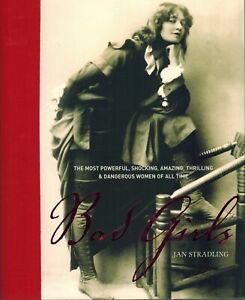
Some of these women fascinate me, and yet I can’t bear to put them under the “favorites” label. Messalina was a force of nature, but even with the incredibly biased surviving records of her life she doesn’t seem like a woman anyone would feel safe or comfortable around. (Speaking of family Christmas wreaths – how about that Julio-Claudian dynasty? Yikes.) Meanwhile, most of us not titled Augustus still appreciate Cleopatra‘s power, love life, and legacy – what’s the difference?
I don’t have an answer for that – maybe part of it’s the timing, with Messalina mired in a world of Caligulas and Claudiuses (Caligulae and Claudii?) while Cleopatra represented a golden idyll of antiquity with Caesar and Antony. Maybe it’s the mystique of Cleopatra’s death, the Liz Taylor movie – but whatever it is, there’s a lot to consider about how and why we feel differently about similar figures who often seized, held, and lost power with similar means.
My favorite figures: Catherine the Great, who needs no introduction; Belle Starr, “Bandit Queen” and Wild West outlaw; I can’t even get to five because there are really a lot of murderers, terrorists, and corrupt politicians included here
Scandalous Women by Elizabeth Kerri Mahon
Whew! Back to the lighthearted fun of women who maybe make some life choices you don’t agree with but who also aren’t serial killers, child traffickers, or crime bosses.
A review of this book on Mahon’s blog of the same name says this kind of accessible history is refreshing to some and “repellent” to some, but I hope if you’ve followed along this far you aren’t in the latter camp because I have no idea what you’re still doing here otherwise.
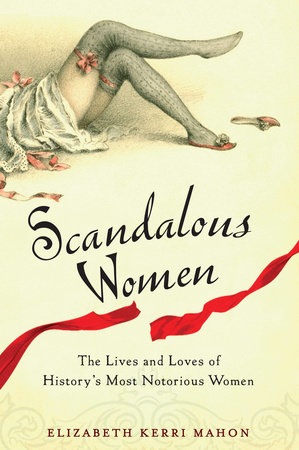
It’s unfortunate that this book fell at the end of my list, because it’s certainly no lesser than any of the others. However, without a strong theme guiding which women are included, I don’t have much more to say than it’s another enjoyable read loaded with juicy information.
Check out Mahon’s blog for an introduction on some of the leading ladies I’ve talked about – speaking of accessibility, that’s a great way to get a feel for her writing style and the type of people included without shelling out money for a new book or trying to track it down at the library!
My favorite figures: Émilie Du Châtelet, physicist, mathematician, linguist, and Voltaire’s mistress – titles listed in order of importance to her; Anne Hutchinson, plague of John Winthrop and most other starched-up Puritan men; Ida B. Wells-Barnett, journalist and correspondent who worked to expose and end racial injustice in the postbellum U.S.; The “Unsinkable” Margaret “Molly” Brown, Titanic survivor and advocator for women’s suffrage and workers’ rights; Mary Wollstonecraft, author, feminist crusader, and of course, mother of Frankenstein author Mary Wollstonecraft Shelley.
Even as I reiterate that most of these books I’ve covered address the same people and grapple with the same failings in the historical records, it’s incredibly interesting to see how different authors approach their subjects in unique ways. To me, that makes it worth it enough to own all of these tomes and compare those perspectives.
I can’t tell you which is more up your particular alley or whose writing will resonate most with you, but I hope by providing these options you can indeed find a new book and historical favorite to learn more about!
Listicles Non-Fiction books Buying New Bookshelves Non-Fiction Women's History Month

 Buying New Bookshelves
1 Comment Leave a comment ›