On Annotating
I’m excited to share that I’ve overcome a month and a half of writer’s block with an idea for a new post series… which will be launching soon! It’s just what you all wanted: revisiting the classics we all had to read in high school English classes, with a new (and hopefully more mature) perspective.
But as I began to re-read the books, I found I had a burning question for other readers – particularly those who also took English classes that required them to annotate.
How do you feel about annotating your books? In particular, having to annotate for a grade, knowing a teacher is going to read it and score your thoughts?
Personally, I hated it. For several reasons, actually. I am not a person who writes in books, much less copiously. Maybe if there’s a quote or line that sticks with me and it’s one of my favorite books, I’ll highlight it on my fifth read-through or so. Just so I don’t lose it again. But by that point I’ve deliberated a lot on whether or not I want to do it. I’ve highlighted so few things that I can name them off the top of my head:
- “After all this time?” “Always.” (Harry Potter and the Deathly Hallows by J.K. Rowling)
- Thoreau quotes that Chris McCandless wrote in his journal (Into the Wild by Jon Krakauer)
- A blurb about Jim Craig and how he approached goaltending, which I also wrote down on notecards and kept in my goalie bag when I first started playing lacrosse (The Boys of Winter by Wayne Coffey)
That’s it, y’all. In my whole life, that is the extent to which I have willingly marked up books.
(However, I do have tabs marking every page in which a character dies in the Game of Thrones series, just out of morbid curiosity. It might take a while to remove those, but they are removable at least.)
Yet when you look at my books from high school lit classes – well, hold that thought, I can’t even look at them. And I do really want to re-read some of them. I loved Hamlet and All The Pretty Horses, and I have a theory about Dr. Jekyll and Mr. Hyde that I’d love to investigate. But I can’t bear to crack them open (gently, in the case of Invisible Man and Lord of the Flies, because the binding has completely fallen apart and they’re taped together) and see all the dumb stuff I wrote when I was 15 and trying not to get a bad grade.
The kicker is that I absolutely hated speaking up in class and knew I was going to get knocked on participation points during discussions. So I overcompensated with my annotations, color-coding them and basically filling up every square inch of margin with “insights” and, more often, dumb quotes (think Taylor Swift song lyrics and The Hangover – it was 2010, okay) or motifs (so much blue) that I could tie together without using much brain power.
The cringe-worthiness hurt me then, but at least the references were current and I was still in the state of rebellious youth where I loved The Catcher in the Rye before I grew up and gained the sense to want to punch Holden square in the nose. Now? The secondhand embarrassment, even detached by a period of 10 years, is excruciating.
That’s probably how I’ll feel if this blog is logged in the Internet Archives and I find it again in another decade.
The point of this tangent is that I annotated like a dutiful little AP nerd, but now it’s ruined those books for me forever. If I bought all-new copies (yes, I did do that for The Great Gatsby and Animal Farm) I’d save myself embarrassment – but no one else wants these marked-up books either and as tattered as they are, throwing books out hurts my soul. Also, it seems silly to re-purchase the ones I didn’t like just to have them on my shelf. And yet… it tempts me.
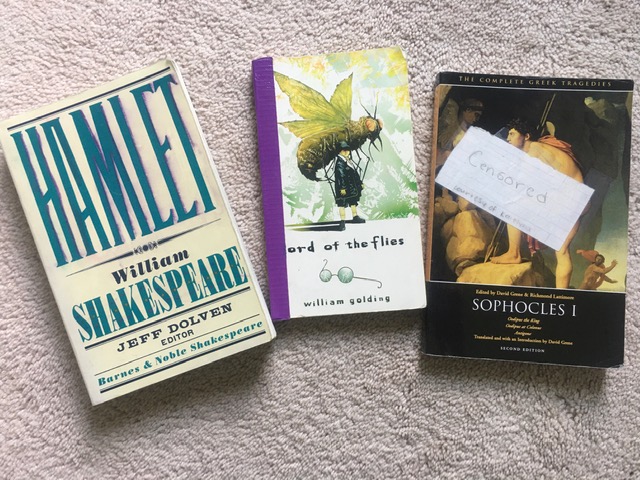
I know some people like to mark up their books and make them feel more loved and lived-in, and reading old notes lets you feel like you’re re-encountering an old friend in your past self.
I might even feel that way if I hadn’t resented annotating so much in high school; the irony was that by taking the time to pressure myself to write notes I fell out of the story and could never actually make the connections that the authors and my teachers wanted. In my one college lit class, I found myself following along much more even though I wasn’t particularly interested in Jane Eyre, mostly because I didn’t have to annotate and I could invest myself in the story enough to see the conclusions and themes the professor was guiding us toward.
So what are your thoughts? Annotating vs. personal note-taking vs. nothing at all? If you do take notes, how did that start? Were you one of those kids in AP Lit I resented because their notes and insights actually made sense and they could come up with theories on the spot?
Answer the poll and/or drop a comment below, and please, if you’re friends with one of our high school English teachers on Facebook, do not link them to this.

 Buying New Bookshelves