If You Like This… You’ll Love That (Pt. 2)
Hey you! Do you tend to go all-in on a topic once you start reading about it and then fall down the rabbit hole for weeks? I do. You know this about me.
But perhaps your cup of tea is, for some reason, a topic other than shark-related disasters, naval disasters, or imperial exploration disasters. I don’t know why, but I guess hypothetically it could be.
Well, for those folks, here’s another edition of “If You Like This… You’ll Love That”. This time we have many DIFFERENT YET LOOSELY RELATED types of disasters to focus on.
Okay, well, we were going to have many of them. But as you may have noticed, I’ve been pretty MIA recently. I’m moving down to grad school literally as we speak – I wrote this in bits and pieces over the last few days in my scant free time, and now that I’ve stopped for lunch on the road I’m posting it – and the next few weeks are about to be even crazier than the past few weeks.
So without further ado, “If You Like This… You’ll Love That” … the cannibalism-only edition.
Warm Weather And/Or Cannibalism
If you like either of the things in the section header above, we probably can’t be friends.
Hot weather is awful. There’s nothing worse than an already boiling day, the humidity turning the air into swampy soup, laziness and bad moods skyrocketing… and also, you’re possibly in a survival situation where you might have to eat each other? Bummer, man. Sorry to hear that.
I misheard? Great! Glad you don’t have to eat each other. Oh – I misheard again, sorry. Now a person or group of people you don’t know are going to eat you, instead of your sad coterie of loose acquaintances? That’s even worse.
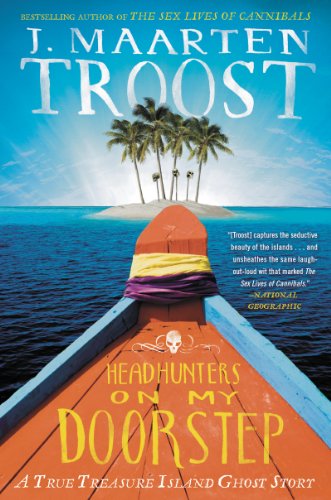
Headhunters on my Doorstep by J. Maarten Troost
Whichever way you prefer your meals – dine-in or delivery – we’ve got you covered. Take, for example, J. Maarten Troost’s loosely connected travelogues from his time in the South Pacific. Beginning with the beguilingly named The Sex Lives of Cannibals and finishing with Headhunters on my Doorstep (in which he follows Robert Louis Stevenson’s path around the Pacific), Troost pulls you in with sensationalist titles to introduce you to an under-appreciated part of the world.
Even thinking of the phrase “the South Seas” conjures up a mythical, dreamy paradise full of beautiful islands and atolls, stunning nature, intricate tattoos – and also violent tribes of native peoples who will eat you as soon as look at you.
In the modern world, there’s certainly some of all that left – albeit more of the first three than the latter – but Troost, who lived in Kiribati for some time and is well acquainted with the area, takes you through the unique islands and cultures with a healthy appreciation for all of them. You may guess from the titles that they aren’t always the most politically correct, but there’s no doubt Troost respects the history of the islands and their peoples, and these books are how he can bring them to the outside world with a healthy dose of introspection and humor.
At least in Headhunters on my Doorstep, Troost encounters no cannibals, but a local in one of his destinations informs him of a German tourist who was recently taken on a trip up some mountains and, allegedly, summarily killed and eaten by his phony guide. Still, Troost takes care to contextualize how cannibalism played into many of these traditional cultures as a religious or wartime symbol – not just eating people for the sake of eating people, like the tribe in the second “Pirates of the Caribbean” movie.
Except for maybe this rogue dude in the mountains.
I know I’ve mentioned it before, but In The Heart of the Sea by Nathaniel Philbrick is a fascinating look at the flip side of the human menu in the Pacific. After the whaleship Essex was battered and broken – intentionally? – by a whale and its sailors cast adrift in lifeboats, many had to resort to cannibalism during the voyage of more than 1,000 miles to the closest bit of land.
Now, like I mentioned in the previous IYLTYLT post, Moby-Dick may not be idyllic about much, but it paints a slightly nicer picture of race relations and tolerance aboard a whaler than what seems to be reality. The Black sailors on board almost all died before the white men – likely because they had to work harder and were given less food to eat – and the last Black survivor was one of the first victims of cannibalism.
By the time the survivors floated into contact with others, there were three marooned on an island and five separated between two rafts, surrounded by bones of their former colleagues, sucking the marrow dry.
How do you come back from that and go back to your home on Nantucket and fit back in? Some of the survivors did, quite successfully.
READ: The Sex Lives of Cannibals, Getting Stoned with Savages, and Headhunters on My Doorstep by J. Maarten Troost; In The Heart of the Sea by Nathaniel Philbrick; Pippi in the South Seas by Astrid Lindgren (what? I loved it as a kid!); Lord of the Flies by William Golding; Krakatoa by Simon Winchester
Cold Weather And/Or Cannibalism
The other day I started reading The Arctic Fury by Greer MacAllister, a novel about a young woman named Virginia “Reeve” who is enlisted to lead an all-female mission through the Arctic to try and find the lost expedition of John Franklin and his ships. Of course I skimmed the synopsis before I checked it out from the library, but I suppose I’d forgotten some of it by the time I actually opened the book. So incidentally, the next two books I had on my “to read” list coincided rather topically.
That’s serendipitous. Unlike pretty much anything that happens in these books.
Now, in theory, I would love to visit the Northern Territories in Canada and hop on down to Antarctica to see the penguins and barren, lunar landscape, and did I mention the penguins? But at least in the modern day we tend to expect safe travels – if we shell out thousands for a cruise to Antarctica, we don’t expect to be dashed to pieces by waves near Tierra del Fuego or allowed to freeze to death alone on an ice sheet. Obviously, in the ages of expansion and exploration, there was no such guarantee.
In fact, you should probably expect the opposite.

Without spoiling anything, hopefully, poor Virginia has had a rather rough go of it in regard to both cold weather and cannibalism. As a guide leading settlers to new Western outposts during the age of Manifest Destiny, she’s seen a lot, but isn’t at all sure what she’ll expect in a new territory. In fact, she’s wholly unqualified for leading this mission, except for in a rather unfortunate way.
You can begin to guess her history as you read (and, probably, once you see the related books in this section) but even with that specter hanging over her head, and yours as the reader, you get a sense of everything this mission could be and that this book contains. It’s very much a modern novel, even set 170+ years ago. Introspective feminism; bisexual or lesbian and transgender characters; a multi-racial main cast – a group of people with the odds stacked highly against them, but do their best and ultimately become a tight-knit group.
Somewhat uplifting, and good morally, even if the content is often dark given the source material: the Donner Party and the Franklin expedition.
I’m not going to touch much on the Franklin expedition here because I know less about it – those books are still on my “holds” list from the library – but one thing I loved about these Donner Party tomes I read is how many different perspectives you can take and how many lenses you can view one fateful expedition through. The Best Land Under Heaven by Michael Wallis focuses more on the Reed family, and to some degree the Donners; meanwhile, The Indifferent Stars Above by Daniel James Brown looks at the lesser-known extended Graves family through the point of view of the oldest daughter, Sarah.
Each family had their own internal struggles and the shifting dynamics within the group as it moved slowly westward led to their disaster as much as the unusual weather did that season. From different writers, you are able to experience many of those different perspectives from the survivors’ accounts – for example, an incident where James Reed killed a teamster working for the Graves family is obviously seen very differently between the two books mentioned above, and is clearly still a source of contention more than a century and a half later.


And yet, it turns out there’s even more to New World-cannibalism than those two expeditions; the U.S. apparently has its very own cannibal extraordinaire in Alfred (sometimes spelled Alferd) Packer, alleged to have killed five companions on a westward expedition for their money and then consumed their bodies – either out of necessity in the barren winter storm, or because he was a murderous fiend and just wanted to. ¯\_(ツ)_/¯
Man-Eater by Harold Schechter is similar to his book about Belle Gunness in that we never have a satisfying resolution – not that that’s Schechter’s fault – as Gunness was determined to be guilty but thought dead, and Packer sat through trial after trial yet escaped the noose. It’s frustrating but full of lurid details. Is it the same side of the coin as the desperate Donner Party, or did Packer have a macabre predilection for what they were driven to in their worst nightmares?
Perhaps the only way we’d know is if we were there in person – which, I think we would all agree – we would not actually want to be.
READ: Man-Eater by Harold Schechter; The Best Land Under Heaven by Michael Wallis; The Arctic Fury by Greer MacAllister; The Indifferent Stars Above by Daniel James Brown; Ice Ghosts by Paul Watson; Fatal Passage and Lady Franklin’s Revenge by Ken McGoogan
Listicles Non-Fiction blog posts books Buying New Bookshelves Fiction IYLTYLT Listicles Non-Fiction

 Buying New Bookshelves
2 Comments Leave a comment ›