Review: Dear Friend, From My Life I Write To You In Your Life
My dad told me the other day he tried to read one of my posts and it was too long so he gave up. Fine. This is a book review I had to write for a journalism class a few years ago, which had a word limit and my professor told me was a “pleasure to read,” so here you go, Dad.
Yiyun Li’s latest book steps away from her usual genre of fiction and immerses the reader in Li’s own life: a life twisted and torn by mental health issues and overwhelming self-doubt, yet still a life strung together through love, changing identities, and, above all, literature.
Though not truly autobiographical – Li abhors autobiographies, and both the ego and self-assuredness that prompt someone to write about their lives – Dear Friend is a poignant memoir that challenges its readers to think about not only their place in time but also their role in the current world. Li began writing this book following two hospitalizations for suicide attempts; as a form of both catharsis and introspection, she melds her writing and reflections with those of other authors she admires.
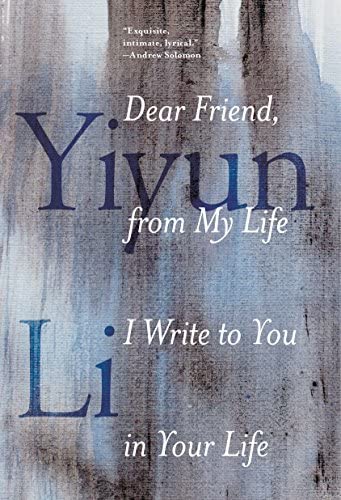
Dear Friend is not an easy read, but it is a rewarding one. On the surface, one must have an intricate knowledge of literature – from ancient Chinese texts to Victorian England romances, from autobiographical Soviet-era picture books to modern letters – or at the very least, a willingness to set down the book to do some cursory research. More deeply, readers must be prepared to confront their own selves and their roles in other people’s lives as Li does the same on the pages.
Suicide and depression are not light topics to discuss at the dinner table, and instead merit an in-depth analysis. It is impossible to know the true magnitude of depression unless you have suffered through it, which Li clearly has. Yet Li, like many of the authors and friends she mentions, has grown to work with it rather than against it.
Li’s writing is, at times, dense and diagnostic. At some points, Dear Friend feels more like a scholarly literature analysis than a memoir. Long quotes are offset in the format of a research paper, surrounded by Li’s take on their context and implications. The title itself comes from one of those literary pieces, from Katherine Mansfield, who is often referenced throughout the book.
With McCarthian sentences and enough dashes to make Emily Dickinson proud, it’s easy to get lost in Li’s text. Though the writing itself frequently nears James Joyce’s stream-of-conscious style, it is not necessary to follow each and every word to understand Li’s story.
Who among us cannot relate to manipulative parents and friends, or undergoing an extreme culture shift, or losing the ability to see the light at the end of the tunnel? Despite the many aspects of Li’s tales that may be too personal or confusing to identify with, there is always an underlying current of things every reader can relate to.
Li repeatedly mentions her distaste for autobiographies, but this book is her diary, published for the masses. At times indulgent and introspective, readers follow her path through recovery and self-discovery – though she would certainly refuse to concede either.
Though Li repeats time and time again that she argues with herself, and attempts to step out of her own mind to contextualize and strike down definitive judgments, she is still an unreliable narrator. Of course, that is through no fault of her own: Li has lived a fascinating, yet utterly depressed and reclusive life, and writes as a product of that, like so many of the other authors she admires and resents.
Occasionally combative, recurrently stubborn, and borderline dissociative, Li is a difficult author to get along with. The overall themes of her writing, though, are hard to ignore, and prompt readers to look at their own lives and their role in the world. What is selfishness? What is innocence? Why should we even bother to continue living?
The book covers are gray; the pages’ edges are jagged. Yet the whole package is an enthralling, albeit difficult, description of one woman’s life, struggles, and literary saviors. The book, like Li, is made up of infinite details and decisions, which ultimately create something that is stronger for all the trials it endured.
Reviews books Buying New Bookshelves Memoir Non-Fiction Reviews

 Buying New Bookshelves
Thanks. I read it all the way to the end.
LikeLiked by 1 person